Units
Scout
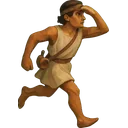
The Scout is a specialist with exactly one job: lifting the fog. It cannot attack — that is not a weakness, it is the identity.
It cannot attack, and it does not pretend to
Attack 0, attack vs. city 0. The engine does not treat this as just another number, it rejects the command outright: try to attack an adjacent rival with a Scout and no red target outline ever appears on the board, and the command comes back as "this unit cannot attack".
That is a deliberate choice. The alternative was to let the attack resolve and deal 0 damage — in which case the battle preview reads "0 / 0", you burn the unit's action and nothing happens. In this game the number you are shown is the number the engine processes (Combat), so an honest refusal beat a lying preview.
It projects no zone of control
A unit that enters a tile adjacent to an enemy unit ends its move there (Combat). The Scout is the exception to that rule: the tiles around it are not a zone of control, and a rival walking past does not halt.
The rule is one-directional, and the reason is threat: a zone of control says "walking past an army standing next to you is not free", and its basis is the threat of attack. A unit with no attack projects no threat. But the Scout's own movement still halts normally inside enemy zones of control — what stops you is the other side's threat, not your own strength.
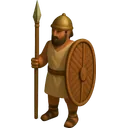
The practical consequence: you cannot use a Scout as a roadblock. Holding a line is the Spearman's job.
It lifts the fog
Vision 7, movement 8 — both the highest on the board, above the Pioneer's. The distance it covers in a turn and the radius it sees work together: it finds the edge of the fog, opens it, and next turn walks to the new edge (Fog of war).
Vision being lower than movement is not an imbalance but a matter of scale: movement points scale with the board's diameter, vision with distance — so the share of the board a single unit sees stays small, and the fog keeps hiding information.
It does not found cities
This is the most important thing the Scout cannot do. When exploration and settlement live in the same unit (Pioneer), exploring costs score directly: a Pioneer walking through the fog is a city you never founded — the city itself, its territory and its population (Territory and score). The Scout removes that contradiction: exploration has its own unit and it takes nothing from your city cap (6).
Caught means dead
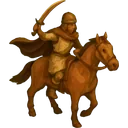
Defense 1, HP 5 — the most fragile thing on the board. On plains a full-health Raider kills a full-health Scout in one blow and takes no counter-damage at all; a dead defender never strikes back (Combat).
That is intentional. The Scout is not a line unit, it is an investment: at 2 production it is the cheapest thing on the board, so losing it is affordable. Escorting it is not worth it — the escort costs more than the Scout does; the right play is to run it away from danger.
If it gets wounded, waiting inside your own territory recovers 2 HP per turn, or 4 if fortified (The turn cycle). There is no healing outside your territory, so a Scout wounded on the road stays wounded.
Upkeep is not cheap
Cheap to build, not cheap to keep: its upkeep is 1, the same as a Spearman's (Economy). A swarm of Scouts is paid for on the food line, not in production. Keep one and work it along the edge of the fog.
When to build it
At the start of the match, while the fog still covers everything. Once you know where the rival cities are, what a Scout adds drops off quickly — and the AI opponent plays by exactly that rule: it keeps its Scout weight low while a scout of its own is in the field or a rival city is already known (The AI opponent).
So the AI keeps one Scout at a time and never swarms. That is not the same as one per match, though: if its scout dies while rival cities are still unknown, it builds a replacement. You can run the same arithmetic — a second Scout earns its cost once the first one is gone and the fog is still closed.
It cannot fight, but it can take
Being unable to attack does not shut the Scout out of the board's neutral structures — only out of taking them by force:
- It cannot clear a bandit camp. By force, a camp only falls when its last bandit is destroyed (Bandit camp), and a Scout cannot hit a bandit at all. Worse, bandits pick the weakest target next to them, so a Scout standing inside a camp's range is first on that list.
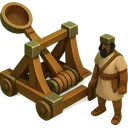
- It cannot wear a neutral village down. With an attack vs. city value of 0, battering a village is a job for the Spearman, the Raider or the Siege (Neutral village).
- But it can buy either with gold. The only board condition for buying a camp or a village is having a unit adjacent to it — that unit does not need to be able to fight. A Scout that reaches a camp first can hand a well-funded empire a ready-made warband.
- It can walk into a fallen city. Taking over a city or village whose HP has been reduced to zero is not an attack but a move: the unit that enters the tile takes the city, and the engine does not care which unit it is (Combat). On the turn someone else breaks the walls, the Scout can be the first one through.
What scouting pays
What a Scout finds is not only information: Ruins pay the first unit that steps on them gold, food or map, once. Being the most mobile unit, the Scout usually wins that race.
All units
| Name | Cost | Upkeep | Move | Attack | Defense | HP | Vision | Attack vs. city | Requires |
|---|---|---|---|---|---|---|---|---|---|
| Pioneer | 3 | 1 | 6 | 1 | 1 | 8 | 5 | 1 | — |
| Spearman | 4 | 1 | 4 | 2 | 3 | 12 | 4 | 2 | — |
| Raider | 6 | 1 | 6 | 4 | 1 | 10 | 4 | 2 | Horse pasture |
| Siege | 8 | 1 | 4 | 2 | 1 | 8 | 4 | 6 | Iron deposit |
| Scout | 2 | 1 | 8 | 0 | 1 | 5 | 7 | 0 | — |

The numbers on this page are read from the game’s balance tables.