Mechanics
The production queue
Every city has its own queue. You put units or buildings in it; production accumulates each turn and the item leaves the queue when it completes.
How production reaches a city
Production collects in a global pool. At the start of each turn, cities draw from the pool in identity order (deterministically).
The draw cap: a city draws at most as much as it produces per turn; if the remaining cost is smaller, it takes only the remainder. If the pool runs out, the cities later in the order get nothing that turn.
A city in revolt draws nothing at all (Victory conditions): you may queue items, even fund them with gold, but nothing completes until the revolt is over.
Reordering the queue
You can change the priority of queued items and cancel one. In both cases the accumulated production stays with the city: the store belongs to the city, not to the item.
This cannot be exploited, because the store never exceeds the cost of the item at the head of the queue — saving up for an expensive item and then promoting a cheap one does not refund the excess, it burns it.
Cancelling a building gives its slot back in the city's building budget.
The building budget
A city holds at most 3 buildings. Once it is full, no new building can enter the queue.
A second limit belongs to the Monument alone: you may build one per empire. If one of your cities already has it — or merely has one waiting in its queue — a second cannot enter any city's queue.
The limit is a building limit: a Monument that arrives by conquest is not demolished and its score is not swallowed. Raise your own and then take a rival's Monument city and you hold two, and both score (Territory and score); the only thing closed is the right to build a third. It cuts the other way too: conquering a Monument city blocks you from building one even if you never raised your own.
| Name | Cost | Effects |
|---|---|---|
| Farm | 5 |
|
| Workshop | 5 |
|
| Market | 5 |
|
| Walls | 8 |
|
| Monument | 15 |
|


The strategic resource prerequisite
Some units can only be built if you own a piece of the map:
| Unit | Resource required |
|---|---|
| Raider | Horse pasture |
| Siege | Iron deposit |
Three rules apply at once:
- The prerequisite is empire-wide. If any of your cities has the resource in its region, you may build the unit in every city. There is no "which city can raise an army" bookkeeping.
- The rejection happens when the item enters the queue. Without the resource the button is disabled and the engine rejects the command with an explicit reason — an item never slips into the queue to stall silently.
- Losing the resource while the item waits does not delete it. The item waits: production does not flow into it, the stored production stays put, and the panel states the reason. The turn you take the land back, the item continues from where it stopped.
A waiting item blocks the queue: production only flows into the head of the queue (see above), so the items behind it stop too. You can reorder the queue to push the waiting item back — stored production stays with the city, so reordering costs you nothing.
Units without a prerequisite are exempt, and deliberately so: the Spearman is the unit that holds a front, and gating it on a tile would leave a player defenceless on an unlucky seed.
What to build
| Name | Cost | Upkeep | Move | Attack | Defense | HP | Vision | Attack vs. city | Requires |
|---|---|---|---|---|---|---|---|---|---|
| Pioneer | 3 | 1 | 6 | 1 | 1 | 8 | 5 | 1 | — |
| Spearman | 4 | 1 | 4 | 2 | 3 | 12 | 4 | 2 | — |
| Raider | 6 | 1 | 6 | 4 | 1 | 10 | 4 | 2 | Horse pasture |
| Siege | 8 | 1 | 4 | 2 | 1 | 8 | 4 | 6 | Iron deposit |
| Scout | 2 | 1 | 8 | 0 | 1 | 5 | 7 | 0 | — |



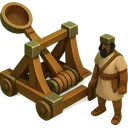

Roughly: Pioneer in the early turns, Spearman when a border tightens, Raider to clear the field, Siege to take a city. The last two depend on the map: take the resource first, then the unit.
The numbers on this page are read from the game’s balance tables.